

Understanding trading terms is the first step to becoming a confident investor in the stock market. If you’re new to trading, the financial world can feel overwhelming with its unique vocabulary and specialized language. This guide breaks down the most common stock market terms you’ll encounter, making them simple and actionable so you can make smarter trading decisions.
What Are Stock Market Trading Terms?
Trading terminology refers to the specific words and phrases traders use when buying and selling stocks. These are the building blocks of financial communication. When you open a trading account with a broker like Samco Securities, you’ll hear these terms daily. Understanding them helps you read market reports, follow trading advice, and execute trades with confidence.
Why does this matter? Because using the wrong term or misunderstanding a concept can lead to costly mistakes. For example, confusing a limit order with a market order could result in buying at a price you didn’t intend. Learning stock trading terminology removes this risk and empowers you to take control of your investments.
How to Use This Glossary
This guide is structured as a complete stock trading glossary with clear definitions and examples. Here’s how to get the most from it:
- Read through the full list first to get familiar with common phrases
- Return to specific terms when you encounter them while trading
- Use the examples to see how terms work in real situations
- Practice using these words when analyzing stocks or discussing trades
The 40 Commonly Used Stock Market Trading Terms Explained
|
Term |
Definition |
How It’s Used |
|
Ask Price |
The lowest price at which a seller will sell a stock |
If you want to buy, you pay the ask price |
|
Bid Price |
The highest price a buyer is willing to pay for a stock |
If you want to sell, you receive the bid price |
|
Spread |
The difference between the bid and ask price |
A narrow spread means the stock is liquid and easy to trade |
|
Volume |
The total number of shares traded in a given period |
High volume indicates strong buyer and seller interest |
|
Market Order |
An order to buy or sell immediately at the current market price |
Used when you want fast execution regardless of exact price |
|
Limit Order |
An order to buy or sell at a specific price or better |
You set a maximum buying price or minimum selling price |
|
Stop Loss Order |
An order that automatically sells a stock when it drops to a set price |
Protects you from bigger losses if a stock falls sharply |
|
Day Trading |
Buying and selling stocks on the same day |
Traders close all positions before market close |
|
Swing Trading |
Holding stocks for days or weeks to profit from price swings |
Takes advantage of short to medium term price movements |
|
Margin Trading |
Borrowing money from your broker to buy more stocks |
Amplifies both gains and losses in your trades |
|
Leverage |
Using borrowed money to increase the size of your investment |
A ratio showing how much you’re using borrowed funds |
|
IPO |
Initial Public Offering – when a company lists on the stock market for the first time |
Investors can buy shares directly from the company |
|
EPS |
Earnings Per Share – a company’s profit divided by shares outstanding |
Higher EPS usually means the company is more profitable |
|
P/E Ratio |
Price to Earnings Ratio – stock price divided by earnings per share |
Helps you see if a stock is expensive or cheap compared to profits |
|
Blue Chip |
Large, stable, well-established companies with strong track records |
Examples include companies like TCS, HDFC, and Infosys |
|
Index |
A basket of stocks that represents the overall market movement |
Sensex and Nifty 50 are popular Indian indices |
|
Futures |
Contracts to buy or sell an asset at a set price on a future date |
Used by traders to profit from price movements without owning the asset |
|
Options |
The right, but not the obligation, to buy or sell an asset at a set price |
Offers flexibility and limited risk compared to futures |
|
Derivatives |
Financial instruments whose value comes from underlying assets like stocks |
Includes futures, options, and forward contracts |
|
ETF |
Exchange Traded Fund – a fund that holds multiple stocks and trades like a stock |
Offers instant diversification with a single purchase |
|
Mutual Fund |
A fund managed by professionals that pools money from investors |
You own a share of a diversified portfolio of stocks or bonds |
|
Liquidity |
How easily you can buy or sell a stock without affecting its price |
Highly liquid stocks can be sold quickly at fair prices |
|
Volatility |
The measure of how much a stock’s price swings up and down |
High volatility means greater price fluctuations and higher risk |
|
Support Level |
A price level where a stock tends to stop falling and bounce back up |
Buyers step in at support levels, creating a floor for the price |
|
Resistance Level |
A price level where a stock tends to stop rising and pull back |
Sellers step in at resistance levels, creating a ceiling for the price |
|
Breakout |
When a stock price moves above resistance or below support |
Often signals a major price move in that direction |
|
Trend |
The general direction a stock price is moving over time |
Uptrend means rising prices, downtrend means falling prices |
|
Portfolio |
Your collection of all stocks, bonds, and other investments |
A balanced portfolio spreads risk across different assets |
|
Bear Trap |
A fake downward price movement that tricks sellers into selling low |
The price then reverses sharply upward, catching bears off guard |
|
Bull Trap |
A fake upward price movement that tricks buyers into buying high |
The price then reverses sharply downward, catching bulls off guard |
|
Short Selling |
Selling a stock you don’t own, betting the price will fall |
You borrow shares from your broker and return them later |
|
Long Position |
Owning a stock and holding it, betting the price will rise |
The traditional way of investing in stocks |
|
Technical Analysis |
Analyzing stock price charts and patterns to predict future movements |
Traders use candlesticks, moving averages, and other tools |
|
Fundamental Analysis |
Analyzing a company’s financial statements to determine its true value |
Looks at revenue, profits, debt, and growth potential |
|
Candlestick |
A chart showing opening, closing, high, and low prices for a time period |
The shape tells you whether buyers or sellers were in control |
|
Order Book |
A real-time list of all buy and sell orders waiting to be filled |
Shows supply and demand at different price levels |
|
Circuit Breaker |
An automatic trading halt when markets move too sharply in one direction |
Prevents panic selling and gives traders time to reassess |
|
Lot |
The minimum number of shares you must buy or sell in one transaction |
For most stocks, a lot equals one share, but derivatives use larger lots |
|
Bull Market |
A market where prices are rising and investor confidence is high |
Good time to buy stocks as the trend is upward |
|
Bear Market |
A market where prices are falling and investor confidence is low |
Prices typically fall 20 percent or more from recent highs |
Deep Dive Into Key Trading Terms
Ask Price and Bid Price
When you look at a stock quote, you’ll always see two prices. The ask price is what sellers want for the stock. The bid price is what buyers are willing to pay. Think of it like haggling at a market. The seller says “I want 500 rupees,” that’s the ask. The buyer says “I’ll pay 480 rupees,” that’s the bid. The difference between them is the spread, and it’s how your broker makes money.
Market Order vs Limit Order
A market order buys or sells immediately at whatever price is available right now. It’s fast but risky because prices move quickly. A limit order lets you set your own price. You say “I’ll buy this stock only if it reaches 250 rupees,” and it waits until that price appears. Limit orders give you control but might never execute if the price never reaches your target.
Stop Loss Order
Imagine you buy a stock at 300 rupees but want protection if it drops. You set a stop loss order at 280 rupees. If the price falls to that level, your shares automatically sell, limiting your loss. It’s like having a safety net. Without it, a bad stock can wipe out your entire investment.
Volatility and Risk
Volatility measures how wild a stock’s price swings are. High volatility means big daily moves, both up and down. Low volatility means calm, steady prices. Volatile stocks offer bigger profit chances but also bigger losses. New traders often do better with stable, low-volatility blue chip stocks before moving to risky, volatile ones.
Support and Resistance
Support is a price where the stock bounces back up because buyers jump in. Resistance is a price where the stock bounces back down because sellers jump in. These are like invisible walls on a chart. When a stock breaks through resistance, it often keeps going up. When it breaks below support, it often keeps going down.
Technical Analysis vs Fundamental Analysis
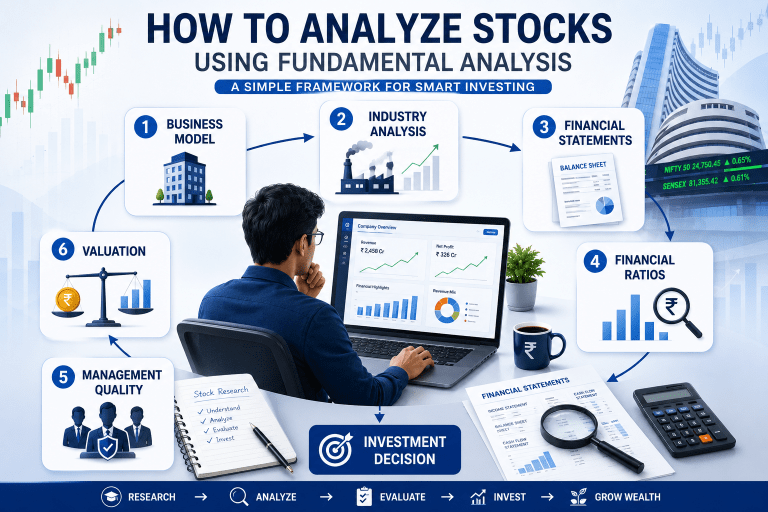
Technical analysis studies price charts and patterns. You’re looking for trends, support, resistance, and signals that tell you when to buy or sell. Fundamental analysis studies a company’s business. You look at earnings, revenue, debt, and growth to decide if the stock is worth buying at its current price. Most successful traders use both.
P/E Ratio Explained
The Price to Earnings ratio tells you how expensive a stock is. If a company makes 10 rupees per share and the stock costs 100 rupees, the P/E ratio is 10. A low P/E might mean the stock is cheap. A high P/E might mean investors expect big future growth. Comparing P/E ratios helps you find undervalued stocks compared to similar companies.
Dividends and Why They Matter
Some companies pay you money directly just for owning their stock. This payment is called a dividend. It’s like the company rewarding you for being a shareholder. Blue chip stocks often pay steady dividends, making them popular with investors seeking regular income alongside potential price growth.
Leverage and Margin Trading
Leverage means borrowing money to invest more than you actually have. If you have 10,000 rupees but want to buy 20,000 rupees worth of stock, you use leverage. Your broker lends you the difference. This doubles your potential profit but also doubles your potential loss. It’s powerful but dangerous for beginners.
Futures and Options
Futures are contracts to buy or sell something at a set price on a future date. Options give you the right, but not the obligation, to do the same. Both are derivatives because their value comes from underlying stocks or indices. They’re tools for advanced traders who want to profit from price movements without buying actual stocks.
How These Trading Terms Work in Real Trading
Let’s say you’re a new trader watching a blue chip stock trading at 450 rupees. You see in the order book that the bid price is 449 rupees and the ask price is 451 rupees. You place a limit order to buy at 450 rupees. Your order waits in the order book.
When the stock reaches 450 rupees, your buy order executes. You now own 100 shares. You immediately place a stop loss order at 440 rupees to protect against big losses. You also set a target to sell at 480 rupees using another limit order.
Over the next week, the stock rises to 475 rupees. The stock breaks through previous resistance levels, signaling a strong uptrend. Your technical analysis shows the stock might keep rising. But you notice volatility increasing, which suggests higher risk ahead.
You decide not to wait for your 480 rupees target. Instead, you place a market order to sell at 475 rupees. Your shares sell immediately. You made a 25 rupee profit per share, which is 2,500 rupees total. Neither your stop loss nor your upper limit order triggered because you exited early.
This simple scenario used limit orders, market orders, stop loss orders, resistance levels, technical analysis, and volatility concepts. Understanding these stock trading terms let you make informed decisions and manage risk properly.
Key Trading Terms for Different Trading Styles
For Day Traders
Day traders focus on volatility, volume, support, resistance, breakouts, and technical analysis. They use market orders for fast execution and tight stop loss orders to protect profits. They avoid holding stocks overnight, so overnight gaps don’t hurt them.
For Swing Traders
Swing traders use fundamental analysis alongside technical analysis. They look for stocks with good trends and strong volume. They use limit orders to enter at good prices and wider stop loss orders because they hold for days or weeks. They watch volatility to understand risk.
For Long-Term Investors
Long-term investors love blue chip stocks that pay dividends. They focus on fundamental analysis, studying a company’s earnings and P/E ratio. They ignore short-term volatility because they’re holding for years. They build a diversified portfolio of quality stocks.
FAQs
What is the difference between bid and ask price?
The bid price is what buyers offer to pay. The ask price is what sellers demand. When you buy, you pay the ask price. When you sell, you receive the bid price. The spread between them is the transaction cost. On liquid stocks with lots of trading, the spread is tiny. On illiquid stocks with few trades, the spread is wider.
What is a market order and when should I use it?
A market order buys or sells immediately at the current best available price. Use it when you want guaranteed execution and don’t care about getting the absolute best price. It’s perfect for selling a stock during bad news when speed matters more than saving a few rupees. Avoid it for less liquid stocks where the price might jump dramatically.
What does margin mean in trading?
Margin is borrowed money from your broker. If you have 50,000 rupees and your broker offers 2x margin, you can trade with 100,000 rupees. You control twice as much stock with the same capital. But if the stock drops, your losses double too. Margin is powerful but risky, especially for beginners who haven’t mastered risk management.
How many trading terms should a beginner know?
Start with the essential 15 to 20 terms covered in this guide. These include bid, ask, market order, limit order, stop loss, volume, volatility, support, resistance, trend, P/E ratio, dividend, and fundamental analysis. Once you’re comfortable with these, gradually learn more specialized terms as you explore different trading styles. There’s no rush to know everything immediately.
Why are trading terms important?
Trading terms are the common language of the market. Without understanding them, you can’t communicate with your broker, read market reports, or understand trading advice. A simple misunderstanding like confusing a limit order with a market order can cost you thousands of rupees. Learning terminology removes this risk and builds confidence in your trading decisions.
What is the difference between support and resistance?
Support is a price level where a stock tends to bounce back up because buyers step in. Resistance is a price level where a stock tends to bounce back down because sellers step in. Think of support as the floor and resistance as the ceiling. When a stock breaks above resistance, it often keeps rising. When it breaks below support, it often keeps falling. These levels are revealed through technical analysis of price charts.
Building Your Understanding of Stock Trading Terminology
Learning 40 stock market terms is like learning 40 new words in a foreign language. At first, it feels overwhelming. But after reading through this glossary a few times and practicing these terms while trading, they become second nature. Start with the fundamental terms today, then expand your knowledge gradually.
The best way to learn is to use these terms actively. Open a trading account, place a few trades using limit orders and stop loss orders, and experience how these concepts work in real life. Reading about terms is helpful, but actually using them while trading makes them stick in your mind permanently.
Remember, every professional trader was once a beginner who didn’t know an ask price from a bid price. They learned by reading guides like this one, asking questions, and gaining hands-on experience. You can do the same. Take your time, master the basics, and your trading will become more confident and profitable.
Common Mistakes Beginners Make With Trading Terminology
Many new traders skip learning these terms properly and jump straight into trading. Then they make expensive mistakes. For example, they place a market order when they meant to place a limit order, and they buy at a much higher price than intended. Or they don’t use stop loss orders, and a bad trade wipes out their entire account.
Another common mistake is using advanced concepts like leverage and options before mastering basic terms. These tools are powerful but dangerous when you don’t fully understand them. Master the basics first, then explore advanced trading tools.
Finally, some beginners ignore fundamental analysis and focus only on technical analysis. Or they do the opposite and ignore charts entirely. The best traders use both approaches together. Understanding stock market terminology in both categories makes you a more well-rounded trader.
Using Your Knowledge to Make Better Trading Decisions
Once you understand these trading terminology concepts, you’ll be better equipped to analyze stocks and make informed decisions. You’ll know how to read charts and understand technical analysis. You’ll understand a company’s financial strength through metrics like P/E ratio and earnings. You’ll know how to protect your trades with stop loss orders and limit orders.
You’ll also understand different market conditions better. In a bull market with low volatility, you can be aggressive. In a bear market with high volatility, you should be more defensive. You’ll recognize support and resistance levels that signal when to buy or sell. You’ll understand when to use market orders for speed and when to use limit orders for precision.
Most importantly, understanding stock trading terms removes the fear and confusion that stops many people from trading. When you know what you’re doing, you make calmer decisions. You avoid panic buying and panic selling. You stick to your trading plan. All of this leads to better results.
Conclusion
Learning trading terms is the foundation of successful stock market investing. This glossary of 40 commonly used stock market terms gives you the vocabulary you need to trade confidently and communicate effectively with other traders and your broker. Whether you’re interested in day trading, swing trading, or long-term investing, these terms form the basis of your trading education.
Start using these trading terminology terms in your daily trading and analysis. Visit Samco Securities to open a trading account and put this knowledge into practice with real trades. Experience how these concepts work in live markets, where real money is at stake. With Samco’s trading platform and educational resources, you’ll have everything you need to master these terms and become a more successful trader.
Remember, the stock market rewards those who understand its language. You’ve now learned the most important words and phrases used in stock trading. Your next step is to apply this knowledge actively, trade responsibly, and continue learning as you gain experience.